How to Screen 500 Resumes Fast
Practical guide to screening high volumes of resumes faster, moreconsistently, and without the fatigue that buries strong candidates. Includes a step-by-stepworkflow.
500 resumes. One role. A hiring manager who needed a shortlist yesterday.
This is not an unusual situation for a recruiter at a growing company, a busy recruitment agency, or a staffing team handling multiple client briefs simultaneously. And the standard advice — “be systematic,” “use a scoring rubric,” “read carefully” — does not survive contact with the reality of 500 PDFs sitting in a folder.
This guide is about what actually works. A practical, honest workflow for screening high volumes of resumes faster without sacrificing the quality of what comes out the other side.
Why speed and quality feel like opposites — and how to stop treating them that way
Most recruiters approach high-volume screening as a tradeoff: you can be fast or you can be thorough, but not both. The faster you go, the more you miss. The more thorough you are, the longer it takes.
This framing is the problem.
Speed and quality are not opposites in resume screening — inconsistency is the enemy of both. The reason manual screening at volume produces poor results is not that recruiters move too fast. It is that they move at different speeds, with different mental models, at different energy levels, across the same pile of resumes. The candidate at position 1 gets a different quality of attention than the candidate at position 287. That variability is where strong candidates get lost.
The goal of a high-volume screening workflow is not to read faster. It is to evaluate consistently — to ensure that candidate 287 gets the same quality of assessment as candidate 1, regardless of what time of day it is or how many resumes you’ve already looked at.
Everything in this guide is oriented toward that goal.
Before you open a single resume: the setup that determines everything
The quality of a high-volume screening process is determined before any resume is read. These steps happen once, at the start, and they shape every decision that follows.
Step 1: Audit the job description before you begin
The job description is the evaluation rubric. If it is vague, your screening will be vague. If it contains contradictions — asking for 10 years of experience in a technology that has existed for 6 years, for instance, or requiring both “deep technical expertise” and “minimal technical background” — your screening will be inconsistent because different resumes will satisfy different parts of the JD.
Before screening begins, read the JD specifically looking for:
- Skills listed as required versus preferred — be clear on which is which before you start
- Seniority signals — “managed a team” means something different from “worked in a team environment”
- Industry or domain requirements — is sector experience mandatory or beneficial?
- Any language that is so generic it provides no screening value — “strong communication skills,” “team player,” “results-oriented” — these should not be factors in your first-pass screening
If the JD has problems, fix them before screening begins. Twenty minutes spent clarifying the JD saves hours of inconsistent screening downstream and significantly reduces back-and-forth with the hiring manager.
Step 2: Define your shortlist criteria in writing, not in your head
Before opening any resume, write down — in a document or even a sticky note — the three to five criteria that a candidate must satisfy to make the shortlist. Not “nice to have.” Must have.
For a mid-level Java developer role in a fintech company, this might be:
- Minimum 4 years of Java development experience
- At least one role in a fintech, payments, or financial services environment
- Hands-on experience with microservices or distributed systems
- Currently at the right seniority level (individual contributor, not director)
These are your gates. A candidate who doesn’t pass all four goes to a separate pile for later review, not automatic rejection. A candidate who passes all four goes into the shortlist pool for deeper evaluation.
Having these written down before you start means your criteria don’t shift as you go. Resume 1 and resume 400 are evaluated against the same list.
Step 3: Batch, don’t stream
If resumes are coming in through an email inbox or job board, resist the urge to screen them as they arrive. Streaming — reading each resume as it lands — creates three problems. You evaluate earlier applicants against a different competitive set than later ones. You create artificial urgency that pushes you toward faster, less careful decisions. And you miss the ability to compare candidates against each other, which is where relative quality becomes visible.
Instead, set a batching window. For most roles, 24 to 48 hours is enough to let the bulk of applications arrive. Then screen the full batch at once.
The screening workflow: three passes, not one
The most effective high-volume screening process uses three passes, each with a different purpose. The first pass is fast and binary. The second is more careful. The third is comparative.
Pass 1 — The gate check (10–15 seconds per resume)
First pass is not about quality assessment. It is about gate compliance. Does this candidate meet the non-negotiable criteria you defined in step 2?
At this stage, you are looking for four pieces of information: relevant experience, approximate seniority level, industry or domain background, and any immediate disqualifying factors. If all four gates are satisfied, the resume moves to the second pass pile. If any non-negotiable is missing, it goes to a separate pile for later review.
The goal of pass 1 is to reduce 500 resumes to a manageable subset — typically 50 to 100 — that genuinely deserve deeper attention. If pass 1 is producing fewer than 10% survival rate, your gates may be too strict. If it is producing more than 40%, either the job board is very well-targeted or your gates are too loose.
Pass 2 — The quality assessment (2–3 minutes per resume)
Second pass is where actual evaluation happens. You are now reading the resumes that passed the gate check with genuine attention — looking for the quality of experience, not just its presence.
At this stage you are asking: how relevant is the experience, not just whether it exists? A candidate with 5 years of Java experience at a single company doing the same work for 5 years is a different proposition from a candidate with 5 years of Java experience across three different contexts, each one increasing in complexity. Both pass the gate check. Second pass distinguishes them.
Score each candidate on your defined criteria — a simple 1-3 scale per criterion is enough. The total gives you a rough rank ordering that informs the third pass.
Pass 3 — The comparative review and shortlist decision (30 minutes total)
Third pass is not about individual resumes. It is about the shortlist as a set. You are reviewing the candidates who scored highest in pass 2 and making comparative decisions: given this specific hiring manager, this specific team, and this specific role, which of these candidates represents the strongest slate to put forward?
This is the stage where human judgment is most valuable and least replaceable. The AI or the structured process got you here. The decision about who to call first is yours.
Where AI changes this workflow
The three-pass process described above is the best manual approach to high-volume screening. But it is still manual — and it has the same structural weakness that all manual processes have: it is only as consistent as the person running it, and it is only as fast as they can read.
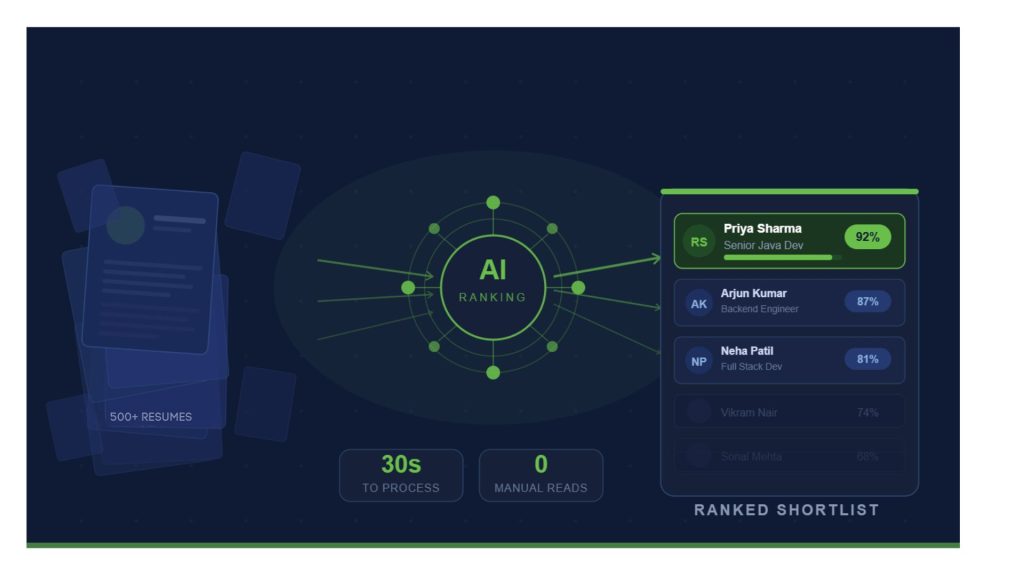
AI resume screening does not replace this workflow. It replaces pass 1 and most of pass 2 with a machine process that is faster, more consistent, and operates without fatigue.
The practical difference: instead of spending 10–15 seconds per resume on 500 resumes for pass 1 (that’s 80 to 125 minutes just for the gate check), you upload all 500 and get a ranked, scored list with explanations in minutes. Pass 1 and pass 2 are effectively combined and accelerated. You spend your time on the comparative review — pass 3 — which is where your judgment actually adds value.
For a role receiving 500 resumes:
| Stage | Manual process | With AI screening |
| JD audit and criteria definition | 20 minutes | 20 minutes (unchanged) |
| Organising and opening the pile | 30-45 minutes | 5 minutes (upload) |
| Pass 1 — gate check | 90-120 minutes | 5-10 minutes (processing + review output) |
| Re-opening, re-checking, losing your place | 20-40 minutes | 0 minutes |
| Pass 2 — quality assessment | 100–150 minutes | 20–30 minutes (reviewing AI output) |
| Pass 3 — comparative review | 30 minutes | 30 minutes (unchanged) |
| Total | 300–375 minutes5-6.25 | 80–95 minutes1.3-1.6 |
“The time saving on a 500-resume role is about 5 hours. Across multiple concurrent roles, that saving compounds significantly.”
But the time saving, while real, is only half the story.
The more significant change is what happens to the quality of your shortlist.
When you screen 500 resumes manually, candidate 1 and candidate 287 do not receive the same evaluation. By resume 150, you are running on pattern recognition rather than structured assessment. The bar has quietly moved. Strong candidates who appear later in the pile – or who describe their experience in language slightly different from the JD – get filtered out not because they’re unsuitable, but because the evaluation ran out of rigour before it reached them.
AI screening applies the same criteria to every candidate with identical rigour. It doesn’t lose its place. It doesn’t lower the bar at resume 300.
For a single HR manager running one or two roles a month, the hours saved matter less than this: how many times has your best candidate been somewhere in that pile – and not made the shortlist – simply because of where they happened to appear in the queue?
AI screening doesn’t just make you faster. It makes your shortlist more accurate. For many teams, that second benefit has more impact on hiring quality than the first.
Save time drastically while maintaining top notch quality levels across your resume screening process: Try running your next high volume project on iRankr for free.
Try it free for 30 days.
Common mistakes that slow you down and cost you candidates
Screening in order of arrival. The first resumes to arrive are not the best resumes. They are simply the fastest. Screening in arrival order creates a false sense of momentum and biases toward candidates who apply immediately rather than candidates who are genuinely strongest.
Using the same JD language as your screening criteria. If your JD says “Python developer” and you screen for the exact phrase “Python,” you will miss candidates who describe the same capability in adjacent language. Screen for competence, not vocabulary.
Making rejection decisions on pass 1. Pass 1 should produce a “maybe” pile and a “strong maybe” pile — not a rejection pile. Resumes that don’t make the shortlist at pass 1 should be held, not discarded. Hiring managers change requirements. Roles evolve. The candidate who didn’t quite fit this brief might be exactly right for the one that opens next month.
Screening alone when team screening is available. Two recruiters independently screening the same pass-2 pile and then comparing notes produces a better shortlist than one recruiter screening alone. Disagreements reveal either genuine ambiguity in the criteria or genuine difference in how the role is being interpreted — both of which need to be resolved before the shortlist goes to the hiring manager.
Not tracking what you’re finding. If you screen 500 resumes and 480 fail at pass 1 because of the same missing criterion — say, no fintech experience — that is information the hiring manager needs. Either the talent market doesn’t have what they’re looking for at the specified seniority and salary, or the JD needs to be revised. Feeding this intelligence back into the sourcing and requirements conversation is part of the recruiter’s value-add.
The shortlist that gets approved first time
The final output — the shortlist you send to the hiring manager or technical reviewer — is the product of all of this work. How you present it determines whether it gets approved quickly or sent back with questions.
A strong shortlist presentation includes, for each candidate:
- A one-paragraph summary of why they are on the list — not their full career history, but the specific reasons they fit this role
- The two or three things that make them particularly strong for this position
- The one or two things that are missing or uncertain, and what to probe in the interview
- A suggested interview focus based on what the CV reveals and what it doesn’t
This level of context takes 5 minutes per candidate to write if you have been screening consistently. It saves 30 minutes of back-and-forth with the hiring manager who would otherwise have to read the full CVs themselves to understand why these ten people are on the list.
If you are using AI screening, most of this context is generated automatically as part of the scoring output — the strengths summary and gaps analysis for each candidate are already there. Your job is to validate, adjust, and present.
When high volume is simply the reality
500 applications is not unusual. For any role with a recognisable brand behind it or a well-distributed posting, it is the normal outcome of recruiting done properly.
The instinct to treat volume as a problem – stricter filters, faster rejection thresholds – typically makes things worse. Keyword filters reduce the pile but introduce a different error: filtering out candidates who would have been strong but didn’t match the JD’s exact vocabulary.
The right response to high application volume is not to see less of it. It is to evaluate all of it without quality degrading as the pile grows.
That is what AI screening is built for. When every resume in a 500-application pool receives the same structured assessment regardless of where it sits in the queue, volume stops being a source of stress and becomes a competitive advantage. More applications means more signal – and a better chance of finding the right person, provided the evaluation system can handle the signal consistently.
The recruiter who can evaluate 500 resumes with the same rigour they’d apply to 50 isn’t just more efficient. They’re making better hiring decisions than the recruiter who filtered down to 50 and hoped the right person made it through.
iRankr screens and ranks your full resume pool – be it 50 or 500 – against your job description in minutes, with explainable fitment scores for every candidate.
Try it free for 30 days.
You Might Be Interested In
How to Write a Job Description That Makes Candidate Screening Easier
Imagine two recruiters screening the same role. One prioritises technical skills; the other focuses on years of experience. Both may be doing their best—but if the job description is vague, they can end up with very different shortlists. A clear job description gives candidates a better picture of the role and gives recruiters a shared [...]

How We Hired a Full Stack Developer in 3 Days with iRankr
We needed to hire a Full Stack Developer, and we needed to move fast. Three days later we had an offer out: 152 applications screened, 6 candidates interviewed, one strong hire, and ₹0 spent on job boards. If you're a recruiter or founder juggling urgent roles against a hiring budget that never stretches far enough, [...]

ATS vs AI Screening: Key Differences Every Recruiter Should Know
If you've ever had a strong candidate tell you they applied for a role but never heard back - and you later found out they never made it through your screening system - you've experienced the most common and least discussed failure mode in modern recruitment. The candidate existed. The application arrived. The system filtered [...]