How We Hired a Full Stack Developer in 3 Days with iRankr
We needed to hire a Full Stack Developer, and we needed to move fast. Three days later we had an offer out: 152 applications screened, 6 candidates interviewed, one strong hire, and ₹0 spent on job boards. If you're a recruiter or founder juggling urgent roles against a hiring budget that never stretches far enough, [...]
We needed to hire a Full Stack Developer, and we needed to move fast. Three days later we had an offer out: 152 applications screened, 6 candidates interviewed, one strong hire, and ₹0 spent on job boards.
If you’re a recruiter or founder juggling urgent roles against a hiring budget that never stretches far enough, the process behind those numbers is probably more useful than the numbers themselves.
Before iRankr, Hiring Looked Like This
Post the job on three or four platforms and hope. Wait for a shared spreadsheet to fill up with a hundred-plus resumes, many vague, generic, or tailored to a completely different role. Spend hours reading through them by hand, or lean on an ATS that’s really just a fancier keyword search. Somewhere around candidate 40, lose the thread of who actually fits. A hiring manager asks for an update you don’t really have.
That is the process we wanted to avoid when this role opened up. Instead, we used iRankr, the AI powered hiring platform we built ourselves, end to end for this hire. Here is how we broke down each pain point and what fixed it.
The Hiring Requirement
Here is what we were looking for:
- Position: Full Stack Developer
- Able to work confidently across both front end and back end
- Experience building and maintaining scalable applications
- Strong communication skills to work closely with the existing team
- Available to join quickly
- Based in or around Delhi NCR
- A strong match against our job description
- Skills and experience aligned with what the role actually needed
Our hiring goals were simple: a genuine technical fit, a startup mindset, and someone who could join fast. To pull this off efficiently, we decided to put iRankr to the test.
Day1:
Creating the Job Description in iRankr
We started by writing a clear job description that outlined the role, responsibilities, required skills, experience, and nice to have skills, along with our timeline. AI assisted JD creation inside iRankr helped us turn this into a structured listing in about 10 minutes. Key takeaway: creating a structured JD took only a few minutes, and that structure is what made accurate AI scoring possible later on.

Sourcing Job Through Social Media
- Posted the Job Opening directly to LinkedIn through iRankr instead of paying for other job boards
- No paid promotion involved, purely organic reach
- Applications started arriving the same day
Key takeaway: a structured JD and a single organic LinkedIn post were enough to get quality applications flowing, with zero spend on sourcing.

Applications into iRankr
email into iRankr’s automated email sync functionality directly applied applications from iRankr

iRankr automatically parsed every resume as it came in – means automatically ranked and reviewed by iRankr.
152 applications were synced without any manual data entry and effort.
Resume Parsed using iRankr:

Key takeaway: automatic parsing meant resumes were ready for scoring the moment they landed, with no formatting or cleanup work on our end.
Day2:
AI screening by iRankr
This was the core of the process. For every one of the 152 applications, iRankr read the resume, compared it directly against our JD, and generated a score, along with a clear explanation of the reasoning behind that score.
- Read and parsed every resume in the pipeline
- Compared each candidate against the JD’s required skills, experience, and location
- Scored every candidate on the same, consistent criteria
- Highlighted missing skills or gaps for each candidate
- Showed the reasoning behind every score, not just a number

We then applied filters for location (Delhi NCR), key skills, and resume score to narrow the pool further. The highest-ranked candidates consistently showed strong alignment across tech stack, relevant experience, and location fit, which is exactly why they ranked above the rest.
Human Touch to the Screening Process
With scoring, we focused only on the highest-ranked candidates rather than working through the full pile.

- The next thing is where human touch became useful –We reviewed each of the 10 candidates using iRankr’s key strengths and gaps breakdown for finer detail beyond the score. 4 candidates were discarded based on this review.
- 6 candidates were finally shortlisted
- 6 shortlisted candidates were sent a drafted email directly from iRankr for interviews
- The score alone told us who looked good on paper. The gaps breakdown told us who was actually worth an interview slot, and it saved us four wasted conversations.
Our hiring goals were simple: a genuine technical fit, a startup mindset, and someone who could join fast. To pull this off inside three days, we needed something smarter than a standard applicant tracking system, so we turned to iRankr.
Day3:
Interviews – The Final Selection
With iRankr-assisted screening, our shortlist came down from 152 candidates to 6 candidates.
- Our team conducted interviews with all 6 strong-standing candidates
- Verified technical depth beyond what the resume score showed
- Assessed communication and cultural fit with the team
To our shock, the interviews validated what iRankr’s scoring had already shown. The highest scoring candidates were consistently the strongest in conversation too, and one candidate stood out clearly across every round and we extended the offer.
Why This Worked
- A clearly written JD is what made accurate AI scoring possible — garbage in, garbage out applies here too
- Scoring every candidate against the same criteria removed the guesswork, and some of the bias, from shortlisting
- Explainable scores, not just numbers, built trust with the hiring manager
- A human pass before scheduling still mattered — AI narrowed the field, judgment picked the finalists
- The time saved was not just speed, it was hours back for sourcing and real candidate conversations instead of resume triage
The Numbers
| Metric | Result |
| Time to create the JD | 10 minutes |
| Applications received | 152 |
| Resumes screened | 152 |
| Candidates shortlisted | 6 |
| Interviews conducted | 6 |
| Time spent screening | 10 to 12 minutes |
| Total hiring time | 3 days |
| Job board cost | ₹0 |
Is This Your Team?
This is worth trying if:
- You’re hiring on a tight timeline with a small or nonexistent recruiting budget
- You’re getting more applications than you can realistically screen by hand
- Your ATS is really just keyword matching with extra steps
- You keep losing good candidates to slow, spreadsheet-driven screening
Final Thoughts
Honestly, Our team wasn’t replaced but could focus more on the real work and it resulted in fast hiring. Hiring does not always require expensive job boards or weeks of resume screening. By combining a clear job description, LinkedIn’s organic reach, and AI powered candidate ranking, we were able to identify and hire a strong full stack developer in just three days, while keeping recruitment costs at zero. Surprising to us as well.
The biggest win was not simply speed. It was freeing our team from manual resume review, so we could focus on meaningful conversations with the best candidates instead.
If your team is dealing with the same sourcing headaches, resume overload, tight timelines, or shrinking hiring budgets, iRankr can help you screen and rank candidates the same way, so you spend your time on people, not paperwork.
You Might Be Interested In

ATS vs AI Screening: Key Differences Every Recruiter Should Know
If you've ever had a strong candidate tell you they applied for a role but never heard back - and you later found out they never made it through your screening system - you've experienced the most common and least discussed failure mode in modern recruitment. The candidate existed. The application arrived. The system filtered [...]

What is Fitment Score?
A fitment score answers a question that every recruiter is trying to answer with every resume they read: how well does this specific candidate match this specific role? Not "is this a good candidate?" That's a different, and in many ways less useful, question. A candidate can be excellent - deep experience, strong track record, [...]
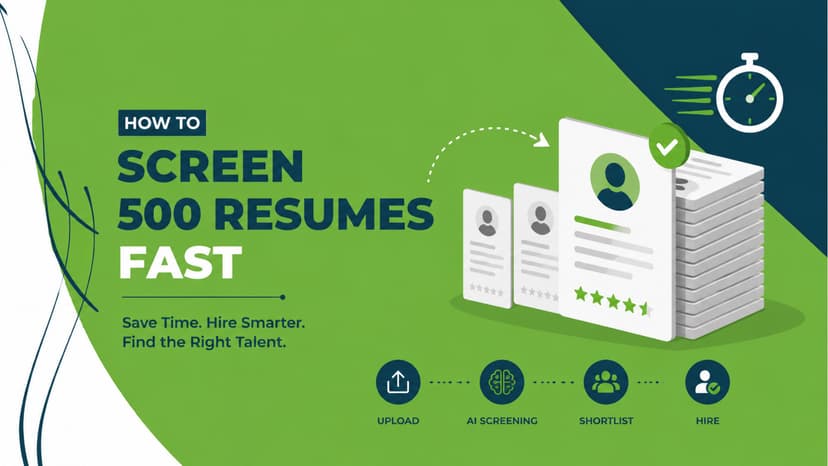
How to Screen 500 Resumes Fast
500 resumes. One role. A hiring manager who needed a shortlist yesterday. This is not an unusual situation for a recruiter at a growing company, a busy recruitment agency, or a staffing team handling multiple client briefs simultaneously. And the standard advice — "be systematic," "use a scoring rubric," "read carefully" — does not survive [...]