What is AI Resume Screening?
AI resume screening automatically scores and ranks candidates againstyour job description. Here's how it works, why it beats keyword matching, and what to lookfor in a tool.

If you’ve spent a morning reading through 200 resumes for one role, you already understand the problem that AI resume screening was built to solve.
The question most recruiters have isn’t whether something needs to change — it’s whether AI is actually the answer, or whether it’s just the latest technology trend being sold to an industry that’s been burned by overpromised tools before.
This guide answers that question honestly. What AI resume screening actually is, how it works under the hood, what it doesn’t do, and how to know whether a tool is worth trusting with your hiring process.
The challenge: Manual screening
Manual resume screening has three fundamental problems that no amount of effort or experience fully solves.
Volume. A mid-level role at a growing company routinely attracts 150 to 300 applications. A popular role at a well-known brand can attract thousands. No human being can read 300 resumes with consistent attention and rigour. By resume 80, cognitive fatigue has set in. By resume 150, you’re pattern-matching off exhaustion rather than criteria.
Consistency. Two recruiters screening the same 50 resumes against the same job description will produce meaningfully different shortlists. Not because one is better than the other — because manual screening is inherently subjective. The first resume sets a benchmark that shifts as the pile grows.
“A candidate who would have made the cut at resume 15 might not make it at resume 115, not because they’re less qualified but because something stronger came between them.”
Retrieval. Most organisations have years of accumulated candidate data — resumes from previous roles, candidates who were strong but not right for that particular position, profiles that arrived at the wrong time. Almost none of this data is actively used. When a new role opens, the search starts from scratch — job boards, LinkedIn, new applications — while the right candidate from eight months ago sits invisible in a shared drive.
AI resume screening addresses all three of these problems. It doesn’t address them perfectly, and it doesn’t replace human judgment. But it addresses them in ways that manual screening structurally cannot.
What AI resume screening actually is
AI resume screening is the process of using artificial intelligence to automatically evaluate, score, and rank a pool of resumes against a specific job description — without a human reading each one individually first.
“The key word in that definition is score. Good AI screening doesn’t just filter resumes into yes and no piles. It produces a ranked list with a score for every candidate, along with the specific reasons behind that score. The recruiter then reviews the top-ranked candidates — not all of them.”
This is the fundamental workflow shift: instead of reading 200 resumes to find 10 worth interviewing, you read the AI’s assessment of all 200 and validate the top 10. The reading work is done by the machine. The judgment work — deciding who to call, what to probe, how to weigh one strength against another — stays with you.
How it works: the difference between old and new
To understand what modern AI screening does, it helps to understand what it replaced.
Traditional ATS keyword matching — the system most organisations have been using for 20 years — works like a search engine from 2003. It scans resumes for the presence of specific words or phrases from the job description. If the JD says “Python” and the resume says “Python,” the candidate passes. If the JD says “Python” and the resume says “I built data processing pipelines using scripting languages,” the candidate fails — even though they’ve described the same capability in different words.
This approach has two well-documented problems. It filters out qualified candidates who express their experience in non-standard language, and it lets through candidates who have learned to stuff their resume with the right keywords regardless of actual depth of experience.
Modern AI resume screening uses a fundamentally different approach. Instead of matching words, it matches meaning.
The AI reads the job description and understands what the role actually requires — not just the words used to describe it, but the underlying skills, experience level, domain context, and seniority signals. It then reads each resume with the same understanding, evaluating what the candidate has actually done and comparing it to what the role actually needs.
A candidate who built payment systems at a logistics company gets recognised as fintech-relevant, even if “fintech” never appears in their resume. A candidate who lists “leadership” as a skill but has never managed anyone gets scored lower than one who describes building and mentoring a team, even if the latter never used the word “leadership.”
This is what is meant by semantic understanding — the AI evaluates meaning, not vocabulary.
What a good AI screening output looks like
The output of AI resume screening should never be just a number. A score without explanation is a black box, and a black box is not something you should be trusting with your hiring decisions.
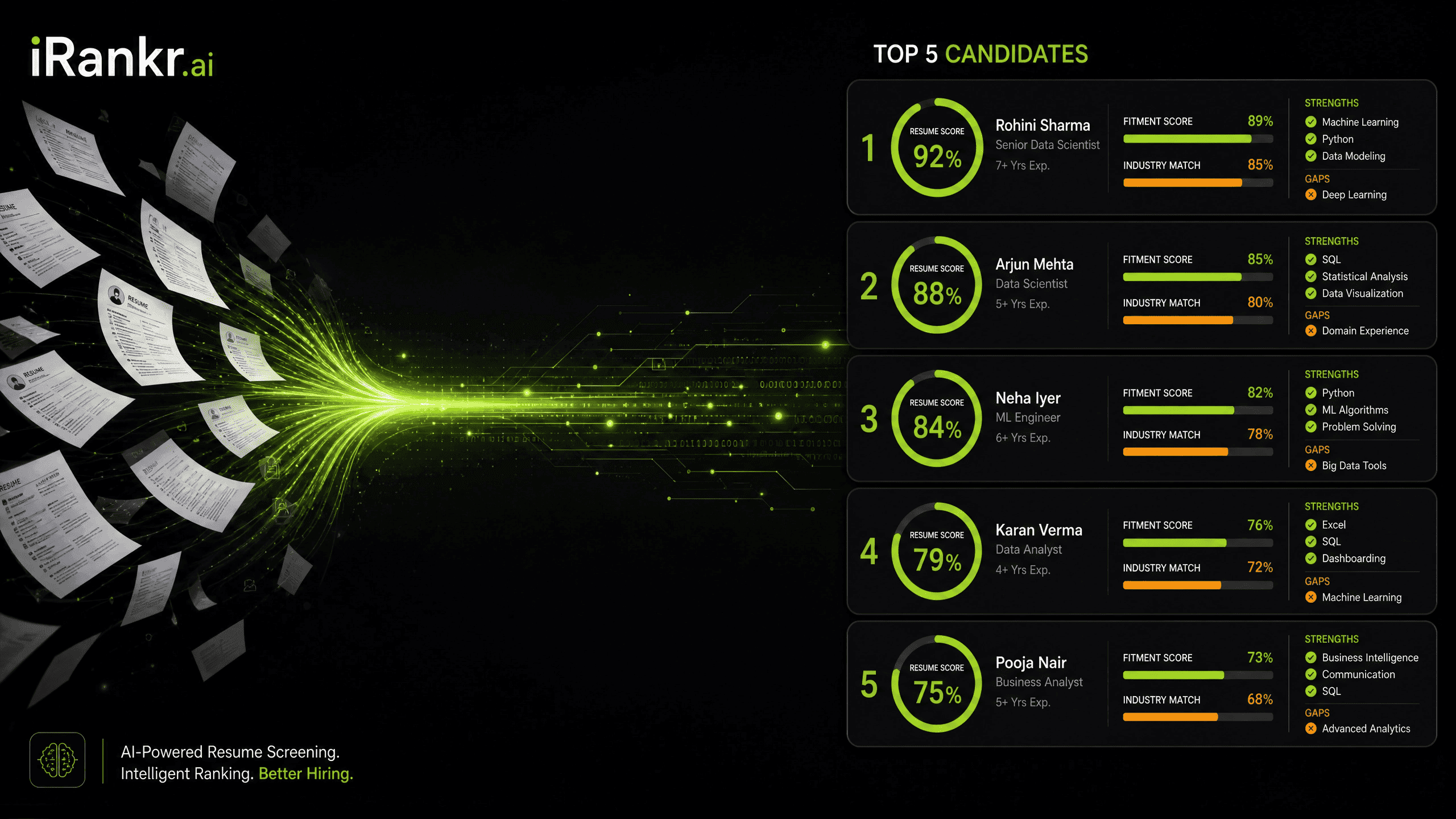
A well-designed AI screening output includes four things for every candidate:
A fitment score — a composite measure of how well the candidate matches the specific role requirements. Not a generic “candidate quality” score, but a role-specific evaluation. The same candidate might score 91% for a mid-level Java developer role and 43% for a senior engineering manager role. The score reflects the match, not the person.
An industry match score — a separate evaluation of whether the candidate’s domain background is genuinely relevant to the hiring organisation’s sector. This matters particularly for roles where industry experience is non-negotiable — a BFSI compliance officer role is fundamentally different from a compliance role in a pharmaceutical company, even if the job title is identical.
A strengths summary — the specific things the candidate brings to this role. Not generic strengths, but role-specific ones. “8 years of Java microservices experience across two fintech companies, with team leadership at the most recent role” is useful. “Strong technical background” is not.
A gaps analysis — the specific ways in which the candidate falls short of the role requirements. This is as important as the strengths, because it tells the interviewer exactly what to probe, and it gives the hiring manager honest context for each shortlisted profile.
“If an AI screening tool produces only a score with no explanation, treat that as a warning sign.”
iRankr provides a fitment score, an industry match score, a strengths summary and a gaps analysis for all shortlisted candidates. Try it free for 30 days.
What AI resume screening does not do
This is important enough to address directly, because a lot of the scepticism about AI in hiring comes from conflating what the technology actually does with what some vendors have overclaimed.
It does not make hiring decisions. AI screening surfaces and ranks candidates. Every decision to advance, reject, or interview a candidate remains with the recruiter or hiring manager. The AI produces a structured starting point for human judgment — it does not replace it.
It does not conduct interviews. Some tools do this — AI-driven video or voice interviews with automated scoring. That is a separate category of technology with its own distinct considerations. Resume screening AI reads documents, not people.
It does not eliminate bias. This is the most important caveat. AI can reduce some forms of bias — specifically the fatigue bias and ordering effects that affect manual screening — by evaluating every candidate against the same criteria with the same rigour. But AI can perpetuate or amplify other forms of bias if it is trained on historical hiring data that reflects past discriminatory patterns, or if the job description it’s given contains biased language.
“A good AI screening tool is bias-aware and transparent about this. A bad one pretends the problem doesn’t exist.”
It is not a replacement for a strong recruitment process. AI screening is a first-pass tool. It improves the efficiency and consistency of the screening stage. It does not improve the quality of your interviews, the accuracy of your offer decisions, or the effectiveness of your onboarding. It solves one problem in the pipeline — an important one, but one.
Who benefits most from AI resume screening
AI resume screening adds the most value in specific contexts:
High-volume roles — any position that regularly attracts more than 50 applications. Below 50 resumes, manual screening is manageable. Above 50, the quality of manual screening begins to degrade in ways that AI can structurally prevent.
Teams screening simultaneously across multiple roles — a recruiter managing 6 open positions cannot give each one the manual attention it deserves. AI screening means every role gets a consistent, rigorous first pass regardless of how many are running in parallel.
Organisations with historical candidate databases — any team that has been collecting resumes for more than a year has a talent pool that manual search cannot effectively access. AI-powered candidate rediscovery turns an archive into an active resource.
Staffing and recruitment agencies — where turnaround time on client submissions is directly linked to revenue, and where a structured, explainable shortlist is a competitive differentiator in client relationships.
Growing companies where hiring pace has outpaced team size — where the alternative to AI screening is either hiring more recruiters or accepting lower shortlist quality.
How to evaluate an AI resume screening tool for your recruiting
Not all AI screening tools are equal. Here is what to look for:
Explainability — can the tool tell you why a candidate scored the way they did? If the answer is no, or if the explanation is vague, the tool is not trustworthy enough to use as a screening layer.
Role specificity — does the tool score candidates against your specific job description, or against a generic notion of candidate quality? The former is useful. The latter is not.
Semantic understanding — does the tool match keywords or meaning? Ask the vendor directly: how would your tool score a candidate who has the right experience but describes it in non-standard language? The answer tells you everything about the underlying technology.
Bias transparency — does the vendor discuss bias openly? What steps have they taken to reduce bias in their scoring model? A vendor who dismisses the bias question has not thought carefully enough about what they’re selling.
Data security — candidate data is sensitive. Where is it stored? Who has access? Can you delete individual candidate records? Is private deployment an option for organisations with strict data requirements?
Integration with your existing workflow — does it work well with or without an ATS? Can it read from your recruitment inbox automatically? Does it require a change in how your team works, or does it sit on top of what you already do?
The bottom line
“AI resume screening is not magic, and it is not a threat to the recruiter’s role. It is a precision tool for a specific, well-defined problem: evaluating large numbers of resumes consistently, quickly, and with enough structure that the results are explainable and defensible.”
Used well, it gives recruiters back the time and mental energy they’ve been spending on reading — and redirects that capacity toward the work that genuinely requires human skill: building relationships, exercising judgment, and making the calls that determine whether a hire succeeds.
The question is not whether AI screening works. The question is whether the specific tool you’re evaluating does it in a way that’s transparent, accurate, and honest about what it can and cannot do.
iRankr is an AI resume screening and candidate ranking tool built for recruiters, recruitment and staffing agencies, and in-house HR teams. You can try it free for 30 days – no credit card required.